Temple · Vrindavan
Shahji Mandir
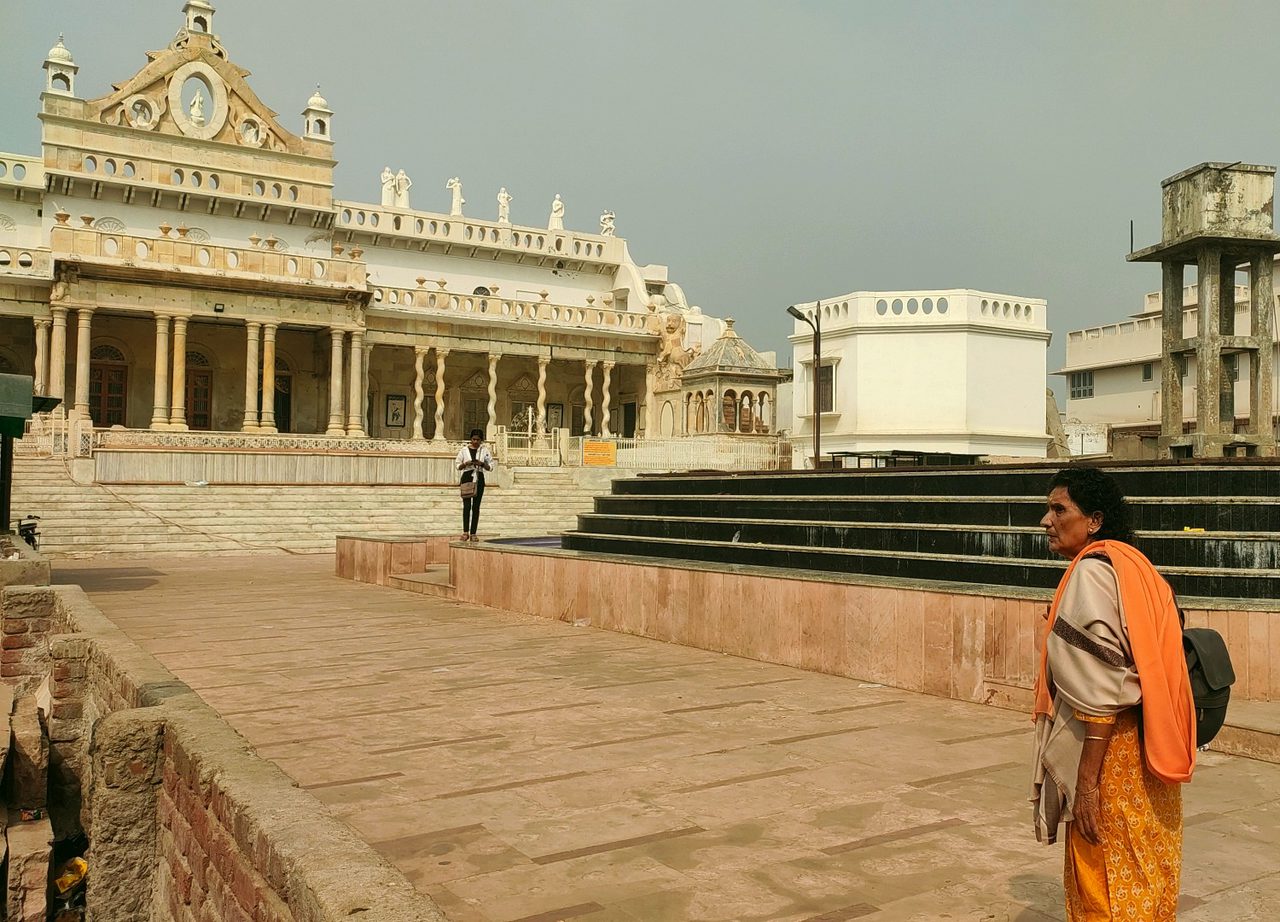
The jewelers' temple — spiral marble columns, Belgian chandeliers, and Vrindavan at its most unabashedly ornate.
The marble front of Shahji — photo by Goutam1962, CC BY-SA 4.0, via Wikimedia Commons (cropped)
- Town
- Vrindavan
- Deity
- Chhote Radha Raman (Krishna with Radha, in a jeweler's setting)
- Origins
- Built 1876 by Shah Kundan Lal and Shah Fundan Lal, jewelers of Lucknow
- Summer hours
- Roughly 7:00 am–12:00 pm and 4:00–8:00 pm
- Winter hours
- Roughly 7:30 am–12:00 pm and 4:00–7:30 pm
- Entry
- Free
- Dress code
- Modest — shoulders and knees covered.
- Photography
- The exterior and courtyard are freely photographed — this is the most photogenic building in the old town; avoid the deity and any posted restrictions inside.
About the hours: The famous Basanti Kamra hall opens only on special days — the temple itself keeps regular hours; confirm locally.
Overview
Every pilgrimage town eventually gets a building that exists because somebody loved God and beautiful things and saw no conflict. Vrindavan’s is Shahji: a white marble confection of 1876 whose twelve spiral columns — each turned from a single marble block — carry a facade closer to a Lucknow palace than to any temple around it. It stands beside Nidhivan, at the heart of the old quarter, entirely unembarrassed.
History
Shah Kundan Lal and Shah Fundan Lal, jeweler brothers of Lucknow and devout Vaishnavas, built the temple as their offering — reportedly after the court culture they served collapsed with the nawabs, redirecting a fortune in craftsmanship toward Braj. Italian marble came by ship and rail; Lucknow’s ornamental instincts came with the family; and the deity, Chhote Radha Raman, was enthroned in a sanctum more finely finished than most palaces of the period. The famous Basanti Kamra — the yellow hall with its Belgian chandeliers — was their durbar for the deity, opened only on the year’s special days.
Spiritual significance
Shahji is a monument to a strand of Braj devotion easily overlooked between the austere Goswami shrines and the great festival temples: opulence as offering. The jewelers gave what they had — marble, craft, splendor — on the same logic as the widow’s lamp or the farmer’s butter. That the temple sits beside Nidhivan, the most secret and austere site in town, is one of Vrindavan’s better jokes about the range of ways to love the same person.
Visiting well
- Come for the architecture in morning light — the spiral columns and carved facade photograph best before the haze builds.
- Ask whether the Basanti Kamra is open; around Basant Panchami and a few festival days it is, and it is worth rearranging a day for.
- Pair with Nidhivan next door — grove and palace, the two extremes of Vrindavan in fifteen minutes.
- The lanes here are tight: come on foot, and give the temple’s quieter side courtyards a look.
Festivals here
Basant Panchami is the temple’s own high day, when the durbar hall opens and everything is dressed in yellow. Jhulan Yatra brings marble-framed swing darshans in the monsoon, and the old quarter’s Holi season fills the lanes outside with color.
While you're here
Around the temple
Nearby attractions
- Nidhivan
- The sacred grove is next door — most visitors see the two together.
- The old-quarter circuit
- Radha Raman, Radha Vallabh, and Radha Damodar all lie within a ten-minute walk.
Eating & staying nearby
- Nidhivan-lane stalls
- Snacks and sweets serve the grove's steady pilgrim traffic; fuller meals are in Loi Bazaar.
- Where to stay
- Old-quarter guesthouses cluster nearby; the temple is deep in the lanes, so arrive on foot or by rickshaw rather than car. See the accommodation guide.
Festivals celebrated here:
Questions
Asked often.
- Why does Shahji temple look so different from Vrindavan's other temples?
- Because its builders were jewelers, not kings or ascetics. The Shah brothers of Lucknow spent a jeweler's fortune and a jeweler's taste on it — Italian marble, twisted single-piece columns, courtly Lucknow ornament — producing something closer to a nawabi palace than a Braj shrine. Vrindavan absorbed it without blinking.
- What is the Basanti Kamra?
- The temple's yellow durbar hall, hung with Belgian glass chandeliers and painted ceilings, opened to visitors only on a few festival days a year — traditionally around Basant Panchami. If your visit coincides, do not miss it.
- What does "Chhote Radha Raman" mean?
- "The little Radha Raman" — the presiding deity is named in affectionate echo of the great Radha Raman shrine nearby, a small image served amid all that marble with old-quarter intimacy.
Visiting?
Planning a trip around Vrindavan?
Hourly, independent trip-planning help from a local — itineraries, bookings in your name, no commissions. The introduction is free.
amit@brajbhoomi.com