Temple · Gokul
Raman Bihari Ji Mandir (Raman Reti)
The sands Krishna played in — a temple, an ashram, a deer park, and the softest ground in Braj.
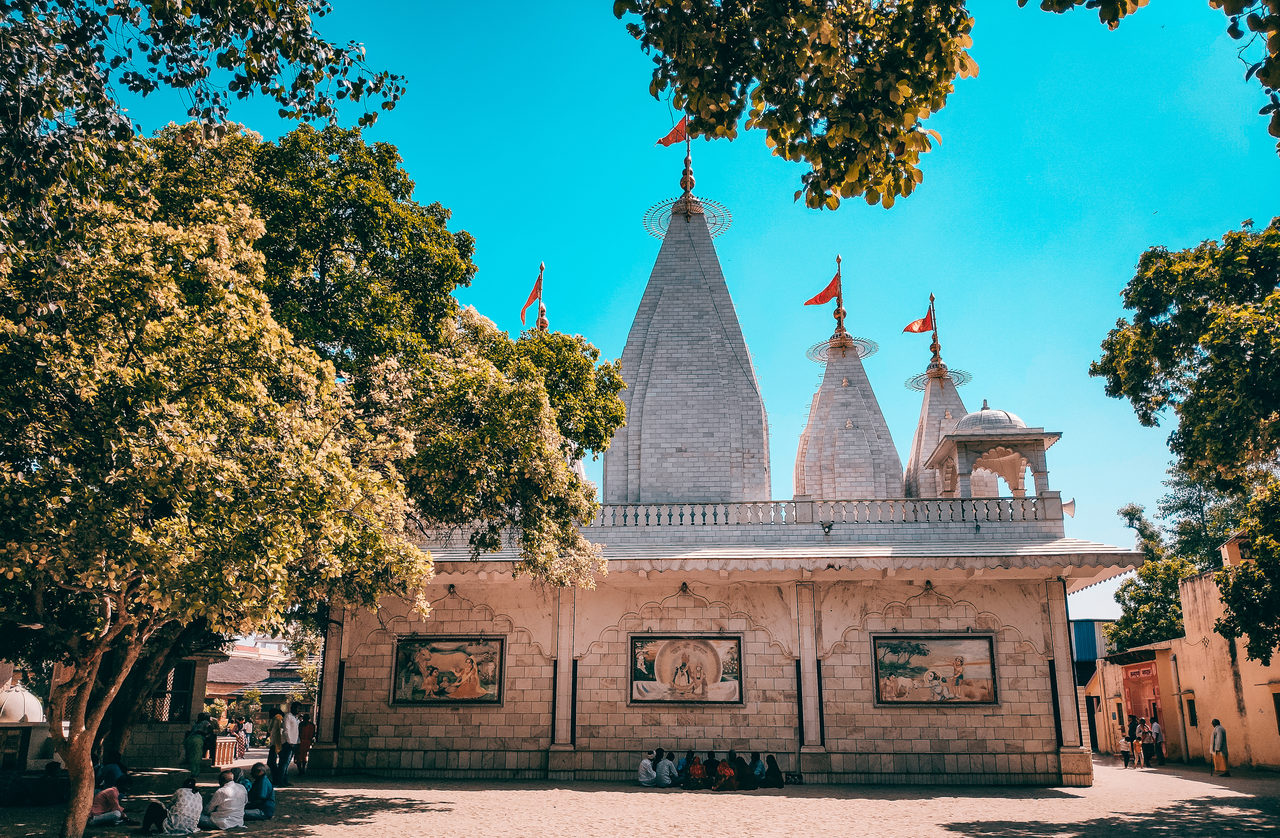
The temple over the sands of Raman Reti — photo by Parth0308, CC BY-SA 4.0, via Wikimedia Commons (cropped)
- Town
- Gokul
- Deity
- Raman Bihari (Krishna at play in the sands)
- Origins
- The sands are the site itself; the Raman Bihari deity was revealed to the saint Gyandas ji some three centuries ago, and the ashram grew around his bhajan seat
- Summer hours
- Roughly 5:00 am–12:00 pm and 4:00–8:30 pm
- Winter hours
- Roughly 5:30 am–12:00 pm and 4:00–8:00 pm
- Entry
- Free
- Dress code
- Modest — shoulders and knees covered. You will want bare feet regardless; the sand is the point.
- Photography
- Relaxed across the grounds and deer park; avoid the deity and be gentle around families with children rolling in the sand.
About the hours: The ashram grounds and sands stay open through the day; shrine hours flex around services — confirm locally.
Overview
Raman Reti is the rare holy place you experience through the soles of your feet. On the Yamuna side of old Gokul, a broad stretch of impossibly soft sand — held to be the playground of the infant Krishna and Balarama — runs between groves, a deer park, and the white shikharas of the Raman Bihari Ji temple. Pilgrims take off their shoes, then their dignity, and roll in it, because that is the prescribed rite here and it is a better one than most.
History
Gokul is where Krishna’s story on earth begins: Nanda Baba’s settlement sheltered the newborn smuggled across the Yamuna from Mathura’s prison, and the town’s sites — Chaurasi Khamba, Brahmand Ghat, these sands — hold his infancy. The sands themselves needed no founding; the Raman Bihari Ji deity was revealed, tradition says, to the saint Gyandas ji as he did bhajan here some three centuries ago, and the Karshni ashram that grew around his seat now keeps the temple, the deer park, and the groves as one unhurried compound.
Spiritual significance
Braj devotion insists that God’s infancy is as much a revelation as his cosmic form — and Raman Reti is that doctrine as landscape. The sand is touched, worn, and rolled in as prasad of place; parents bring toddlers to take their first steps where Krishna took his. It is also the gentlest introduction to Braj piety that exists: no crush, no queue, just riverbank, deer, and the sound of bhajan from the ashram hall.
Visiting well
- Go barefoot early — the sand is cool and at its softest before mid-morning; summer afternoons scorch it.
- Roll, or at least sit — standing at the edge photographing others misses the entire point of the place.
- Give the deer park twenty minutes if children are along; it is the best-loved corner of the compound.
- Pair with Chaurasi Khamba and Brahmand Ghat for the full Gokul half-day, ideally from Mathura.
Festivals here
Janmashtami and the days around it are Gokul’s high season — the town that received the newborn celebrates hardest, and Nandotsav here is among the oldest observances in Braj. Spring Holi on the sands is a gentler, more familial affair than the Barsana–Nandgaon storm — colors, bhajan, and sand in everything by noon.
While you're here
Around Raman Bihari Ji Mandir (Raman Reti)
Nearby attractions
- Chaurasi Khamba (Nand Bhavan of Gokul)
- The eighty-four-pillared hall in old Mahavan held to be Nanda Baba's original house — Krishna's infancy under one roof of ancient columns.
- Brahmand Ghat
- The Yamuna ghat where Yashoda looked into her son's mouth and saw the universe — one of the tenderest sites in Braj, minutes away.
Eating & staying nearby
- Gokul's bazaar sweets
- Milk sweets are the town's trade — try the makhan-mishri that the infant Krishna's story runs on.
- Where to stay
- Gokul offers little beyond dharamshalas; Mathura is fifteen minutes across the river and most visitors come as a half-day trip. See the accommodation guide.
Festivals celebrated here:
Questions
Asked often.
- What exactly is Raman Reti?
- A stretch of fine, soft riverbank sand where the infant Krishna and Balarama are held to have played and rolled — raman means delighting, reti means sand. Pilgrims still roll in it, adults included, and leaving without sand in your clothes is considered doing it wrong.
- What is the deer park?
- The ashram keeps a large enclosure of spotted deer beside the sands — kept for the mood of the old forest groves, and loved by children. Feed is available at the gate; treat the animals gently.
- How does Gokul relate to Vrindavan in Krishna's story?
- Gokul comes first. Nanda Baba's household sheltered the newborn Krishna here after his midnight rescue from Mathura's prison, and his infancy — the cradle, the first butter, the first miracles — belongs to Gokul and Mahavan before the family moved on toward Nandgaon and the Vrindavan pastures.
Visiting?
Planning a trip around Gokul?
Hourly, independent trip-planning help from a local — itineraries, bookings in your name, no commissions. The introduction is free.
amit@brajbhoomi.com