Temple · Vrindavan
Shri Radha Vallabh Mandir
The temple of Radha's name — five centuries of love-poetry set to music in the old town's most devoted lane.
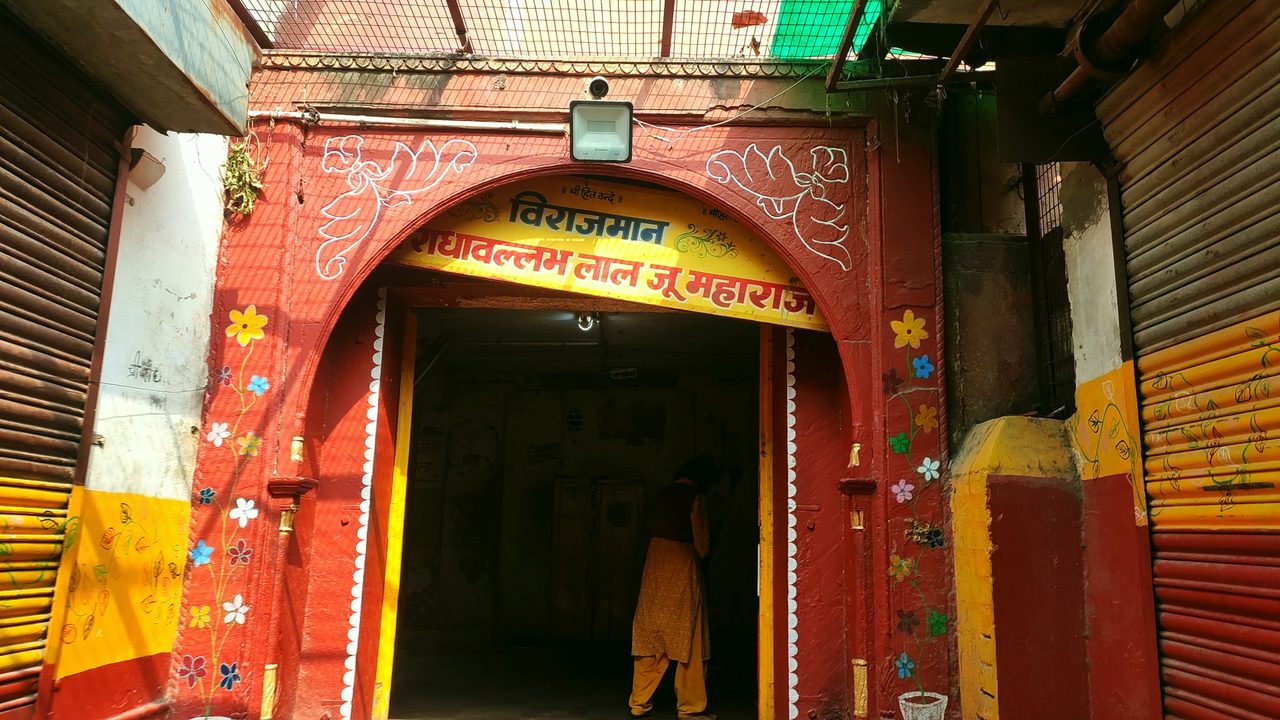
The lane gate into Radha Vallabh — photo by Goutam1962, CC BY-SA 4.0, via Wikimedia Commons
- Town
- Vrindavan
- Deity
- Radha Vallabh (Krishna as the beloved of Radha)
- Origins
- Deity installed by Hith Harivansh Mahaprabhu in 1535; old temple raised 1626, present shrine beside it in the 19th century
- Summer hours
- Roughly 5:30 am–12:00 pm and 6:00–9:00 pm
- Winter hours
- Roughly 6:00 am–12:00 pm and 5:00–8:30 pm
- Entry
- Free
- Dress code
- Modest and conservative, as in all the old-quarter temples — shoulders and knees covered.
- Photography
- Not of the deity. The lanes and gateways outside are photogenic and nobody minds.
About the hours: A working sampradaya seat — hours flex around the day's services and singing; confirm locally.
Overview
Radha Vallabh is the temple of a single idea carried to its limit: that Radha’s name outranks every other name. Its founding saint wrote love poetry rather than philosophy, its liturgy is sung rather than recited, and its deity shares the altar with a crown marking a presence too exalted to carve. With Radha Raman a few lanes away, it anchors the most concentrated devotional quarter in Vrindavan.
History
Hith Harivansh Mahaprabhu (1502–1552) received the small image of Radha Vallabh — “the beloved of Radha” — on his way to Vrindavan, where he settled, taught, and installed the deity in 1535. His movement crystallized into the Radha Vallabh Sampradaya, with this temple as its seat. A grand red sandstone temple built for the deity in 1626 was damaged in Aurangzeb’s era; the image was kept safe, and worship eventually moved to the present shrine raised beside the old shell in the nineteenth century. Both still stand together — the wounded old building and the living new one — which is Vrindavan’s history in a single courtyard.
Spiritual significance
The tradition’s devotion is Radha-first: Krishna is worshipped here as hers. There is no separate Radha image — a crown beside the deity marks her presence, a theological statement made in negative space. The community’s daily samaj gayan, antiphonal singing of Harivansh’s Hindi verse, has run for centuries and gives the temple its texture: this is a shrine you hear as much as see.
Visiting well
- Time your visit to a singing session — ask at the gate when samaj happens that day; it transforms the visit.
- Step into the adjacent old temple shell if it’s open; the 1626 sandstone hall is a quiet, powerful ruin.
- Combine with Radha Raman and the groves for the classic old-quarter circuit, ideally before the midday closing.
- Move gently: these lanes are residential, devotional, and centuries older than tourism.
Festivals here
Radhashtami, Radha’s appearance day, is this temple’s crown of the year — expect the whole quarter dressed and singing. Jhulan Yatra fills the courtyard with swings in the monsoon, and the founder’s own appearance anniversary is kept with special samaj that devotees travel far to hear.
While you're here
Around the temple
Nearby attractions
- Radha Raman Mandir
- The self-manifested deity of Gopala Bhatta Goswami is minutes away — the two temples make one unhurried old-quarter morning.
- Seva Kunj and Nidhivan
- The sacred groves of the nightly lila lie within the same web of lanes.
Eating & staying nearby
- Old-quarter halwais
- Generations-old sweet shops thread the lanes between here and Radha Raman — quieter and better than the big-bazaar stalls.
- Where to stay
- Simple guesthouses and ashram rooms in the old quarter put you inside the town's dawn-to-dark devotional rhythm; most modern hotels sit farther out. See the accommodation guide.
Festivals celebrated here:
Questions
Asked often.
- Why is there no image of Radha at Radha Vallabh?
- Radha is present as a crown placed beside Krishna rather than as a separate image — in this tradition she is too exalted to be represented at all. The temple's whole theology lives in that empty, honored space.
- What is the Radha Vallabh Sampradaya?
- A devotional lineage founded by the sixteenth-century saint-poet Hith Harivansh, for whom Radha's name stands above every other sacred formula. Its worship is unusually musical — poetry and song carry the liturgy more than ritual does.
- What is samaj gayan?
- The tradition's signature congregational singing — antiphonal verses of Harivansh and the lineage's poets, performed daily in the temple. Catch it if you can; it is among the oldest continuous musical traditions in north India.
Visiting?
Planning a trip around Vrindavan?
Hourly, independent trip-planning help from a local — itineraries, bookings in your name, no commissions. The introduction is free.
amit@brajbhoomi.com