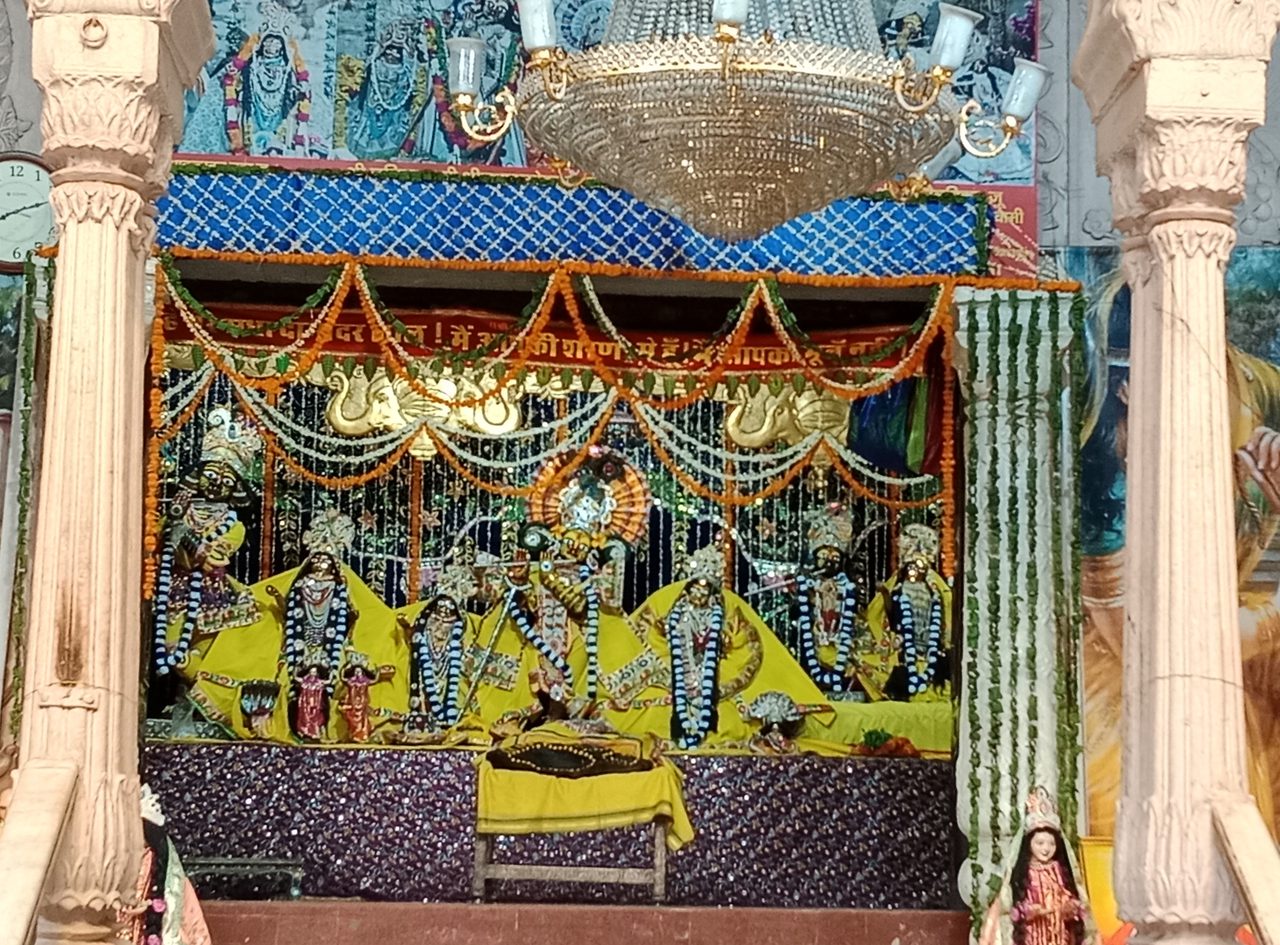
Temple · Vrindavan
Shri Radha Damodar Mandir
The scholars' temple — Jiva Goswami's seat, Rupa Goswami's samadhi, and a Govardhan parikrama four courtyard-circles long.
Radha Damodar on the altar — photo by Kridha20, CC BY-SA 4.0, via Wikimedia Commons
- Town
- Vrindavan
- Deity
- Radha Damodar (Krishna bound with love — the deities carved by Rupa Goswami)
- Origins
- Deities installed 1542; served in the line of Jiva Goswami ever since
- Summer hours
- Roughly 6:30 am–12:30 pm and 5:00–9:00 pm
- Winter hours
- Roughly 6:30 am–12:00 pm and 4:30–8:30 pm
- Entry
- Free
- Dress code
- Modest and conservative — an orthodox old-quarter shrine. Shoulders and knees covered.
- Photography
- Not of the deities. The courtyard and samadhis are generally tolerated; ask, and be discreet.
About the hours: A working Goswami temple with a full service calendar — hours flex; confirm locally.
Overview
Radha Damodar is a small courtyard temple that outweighs buildings fifty times its size. Founded in 1542 by Jiva Goswami, the youngest and most prolific of Vrindavan’s six Goswamis, it holds the deities his uncle Rupa Goswami carved, the samadhis of both men, a Govardhan shila pressed — tradition says — by Krishna’s own foot, and the two rooms where Srila Prabhupada prepared the mission that carried this tradition to the world. Scholars call it the heart of Gaudiya Vrindavan, and they are not exaggerating.
History
Rupa Goswami carved the small Damodar image himself and gave it to his nephew and student Jiva, who installed it in 1542 and built the temple that became the tradition’s intellectual center — its library held the Goswamis’ original manuscripts. When Aurangzeb’s forces menaced Vrindavan in the 1670s the original deities traveled to Jaipur, where they are still served; worship here continued with pratibhu images, unbroken. Rupa and Jiva rest in the courtyard, and in 1959 a septuagenarian sannyasi took two rooms beside their samadhis to translate and write — leaving in 1965, for New York, as A.C. Bhaktivedanta Swami Prabhupada.
Spiritual significance
Three gravities pull pilgrims here. The deities — carved by the tradition’s greatest theologian for its greatest scholar. The samadhis — Rupa Goswami defined what Braj devotion is, and devotees circumambulate his resting place as a rite in itself. And Sanatana’s shila — the Govardhan stone bearing Krishna’s footprint, which makes four circuits of this courtyard equal one 21-kilometer parikrama of the hill. Few temples anywhere compress so much of a tradition into so little ground.
Visiting well
- Circle the temple four times — join the parikrama flow in the courtyard; it is the temple’s signature act.
- Ask to see Prabhupada’s rooms (usually open in daylight hours); ISKCON pilgrims worldwide come for these two rooms alone.
- Pay respects at Rupa Goswami’s samadhi even if the names mean little to you yet — watch the devotees there and you’ll understand the temple.
- Come during Kartik, when the courtyard parikrama runs from before dawn and the lamp-lit evenings are the old town at its best.
Festivals here
Janmashtami and Radhashtami are kept with old-quarter depth rather than spectacle; Jhulan Yatra brings swings to the courtyard; and the disappearance days of Rupa and Jiva Goswami draw scholars and devotees from every branch of the tradition to the samadhis.
While you're here
Around the temple
Nearby attractions
- Seva Kunj and Nidhivan
- The sacred groves are minutes away through the lanes — this corner of the old town is the tradition's densest ground.
- Radha Raman and Radha Vallabh
- The other great Goswami-era shrines make a single unhurried circuit with this one.
Eating & staying nearby
- Loi Bazaar eateries
- The old bazaar's sweet shops and simple thali houses are a short walk; the temple lanes themselves stay quiet.
- Where to stay
- Old-quarter guesthouses and ashrams surround this part of town; several cater to long-staying pilgrims who come precisely for this temple's daily rhythm. See the accommodation guide.
Festivals celebrated here:
Questions
Asked often.
- Why do pilgrims circle this temple four times?
- Tradition holds that Krishna gave the aged Sanatana Goswami a Govardhan shila marked with his own footprint and told him that circling this temple four times would equal one parikrama of Govardhan hill — mercy on a devotee too old for the 21 km. The shila is honored inside, and pilgrims keep the arithmetic to this day.
- Who is buried in the courtyard?
- The samadhis of Rupa Goswami — the tradition's greatest theologian — and of Jiva Goswami, the temple's founder, stand in the compound, along with the bhajan seats where they worked. For Gaudiya Vaishnavas this is some of the most sacred ground in the world.
- What is Srila Prabhupada's connection to Radha Damodar?
- Before founding ISKCON, A.C. Bhaktivedanta Swami lived in two small rooms here from 1959 to 1965, translating the Bhagavatam beside Rupa Goswami's samadhi before sailing for America at age 69. The rooms are preserved and open to visitors — the modest launch-point of a worldwide movement.
Visiting?
Planning a trip around Vrindavan?
Hourly, independent trip-planning help from a local — itineraries, bookings in your name, no commissions. The introduction is free.
amit@brajbhoomi.com