Temple · Vrindavan
Pagal Baba Mandir
The mad saint's white tower — ten storeys, mechanical puppet lilas, and the best-loved family stop on the Mathura road.
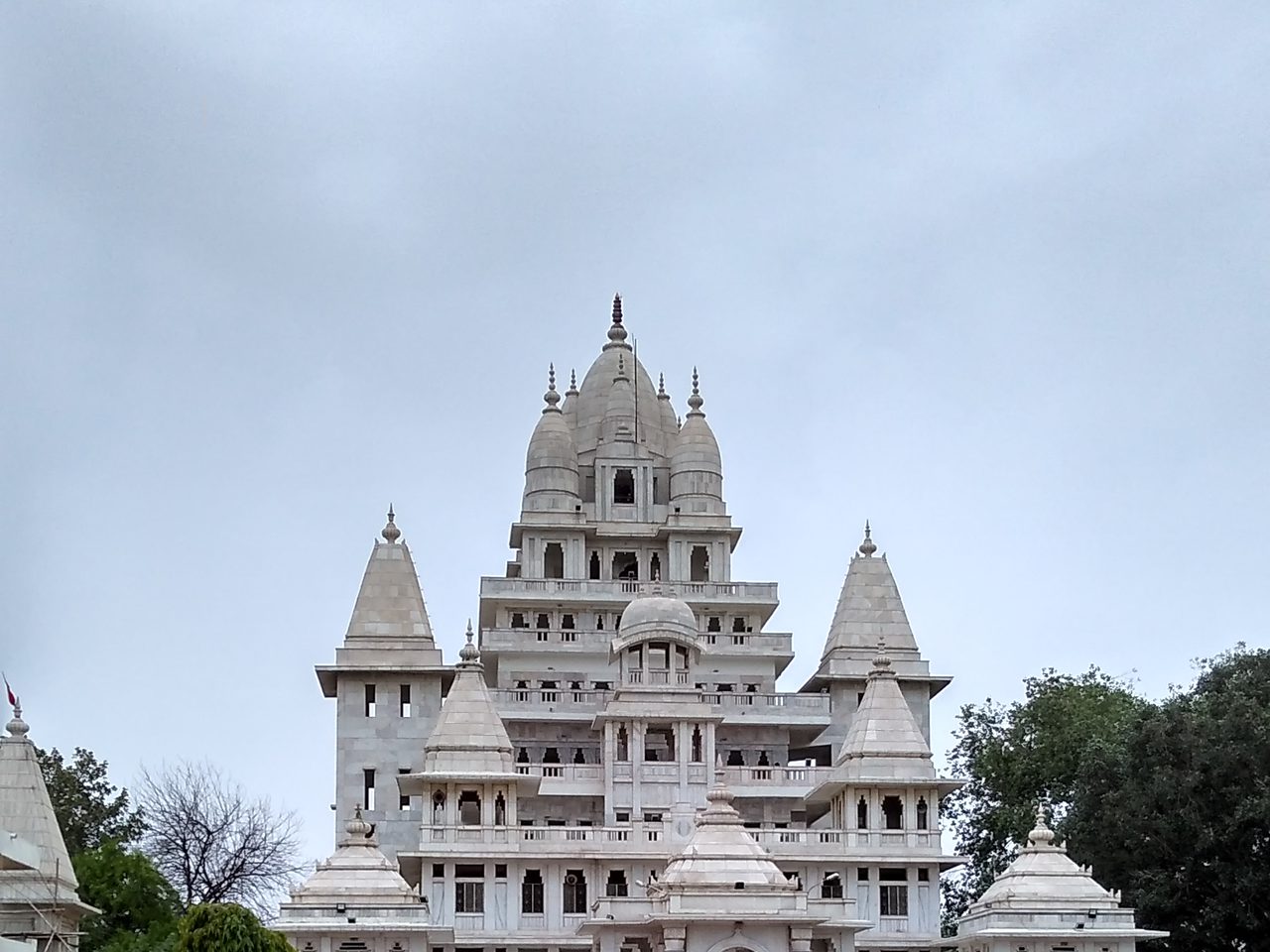
The nine-storey tower from the forecourt — photo by Dhaked, CC BY-SA 4.0, via Wikimedia Commons (cropped)
- Town
- Vrindavan
- Deity
- Krishna, with Rama and the avataras through nine storeys of white marble
- Origins
- Built in the 20th century by the followers of Pagal Baba (Sri Lilanand Thakur)
- Summer hours
- Roughly 6:00 am–12:00 pm and 4:00–8:30 pm
- Winter hours
- Roughly 6:30 am–12:00 pm and 4:00–8:00 pm
- Entry
- Free
- Dress code
- Modest — shoulders and knees covered. Comfortable feet for nine floors of stairs if you climb.
- Photography
- Relaxed throughout — the dioramas are made to be enjoyed; avoid flash at the main shrine.
About the hours: The puppet-show floor keeps its own hours within these — mornings are the safest bet; confirm locally.
Overview
Halfway along the pilgrim road between Mathura and Vrindavan a white marble tower rises nine storeys out of the fields — Pagal Baba Mandir, the most cheerful building in Braj. Downstairs, mechanical puppets act out Krishna’s lilas in glass-fronted dioramas; upstairs, shrine follows shrine to a rooftop view of both holy towns. It is the region’s great family temple — the one children beg to stop at — and it was built for a saint whose title translates as “the madman.”
History
Sri Lilanand Thakur was a twentieth-century Bengali saint — by the world’s accounting a distinguished man, by his own a fool for God, weeping and dancing his devotion so openly that “Pagal Baba,” the mad sadhu, became his name and he embraced it. His followers built the tower in his memory on the Mathura road: white marble in tiered Nagara storeys, a staircase of the avataras, and — his signature gift to pilgrim families — the floor of moving puppet tableaux, a Bengali folk-art of animated lila scenes preserved here at scale after fading nearly everywhere else.
Spiritual significance
“Pagal” is a technical term in Braj devotion, not just a nickname: the tradition’s poets rank the divine madman — the devotee past caring how love looks — above the scholar and the ritualist. The temple institutionalizes that teaching gently: come, watch puppets, climb stairs, laugh, and leave a little less guarded than you arrived. That is the doctrine, delivered at a child’s eye level. The tower’s dedication through the avataras also makes it one of the few Braj temples where Rama’s story shares the building with Krishna’s.
Visiting well
- Bring the children — this is Braj’s best temple for them, and the puppet floor is the reason; give it half an hour.
- Climb to the roof on a clear morning for the corridor view — both towns, the fields, and the pilgrim road below.
- It is a natural break in the Mathura–Vrindavan journey rather than a destination — pair it with Janmabhoomi on one side or Prem Mandir on the other.
- Weekends and school holidays bring family crowds; weekday mornings are quietest.
Festivals here
Janmashtami turns the diorama floor into the temple’s own theatre of the birth story, and Holi week catches the road outside at full festival flood. Ram Navami gets unusual prominence for a Braj temple — the avatara floors make it a natural second feast.
While you're here
Around the temple
Nearby attractions
- The Mathura–Vrindavan road temples
- The tower sits on the pilgrim corridor between the two towns — Prem Mandir and the ISKCON campus lie toward Vrindavan.
- Mathura's Janmabhoomi
- Krishna's birthplace complex is twenty minutes toward Mathura — this stop breaks the journey naturally.
Eating & staying nearby
- Highway dhabas
- The corridor between the towns runs on roadside thali and chai stops; better sweets await in either town's bazaar.
- Where to stay
- Hotels line the Mathura–Vrindavan corridor within a short drive; nobody stays at the temple itself, but everyone stops. See the accommodation guide.
Festivals celebrated here:
Questions
Asked often.
- Who was Pagal Baba?
- Sri Lilanand Thakur, a Bengali saint whose devotion was so unguarded that the world called him pagal — mad — and he took the insult as a title. His followers raised the great white tower in his memory; the "madness" it commemorates is the tradition's highest compliment.
- What are the puppet shows?
- The lower floor houses mechanical diorama tableaux — moving puppets enacting scenes of Krishna's and Rama's lives, a folk-art form now nearly extinct elsewhere. Children are transfixed; adults who let themselves watch usually are too.
- Is it worth climbing the tower?
- On a clear day, yes — the upper floors step through shrines of the avataras, and the top opens views over the whole Mathura–Vrindavan corridor: parrot-green fields, the road of pilgrims, and both holy towns at once.
Visiting?
Planning a trip around Vrindavan?
Hourly, independent trip-planning help from a local — itineraries, bookings in your name, no commissions. The introduction is free.
amit@brajbhoomi.com