Temple · Vrindavan
Nidhivan
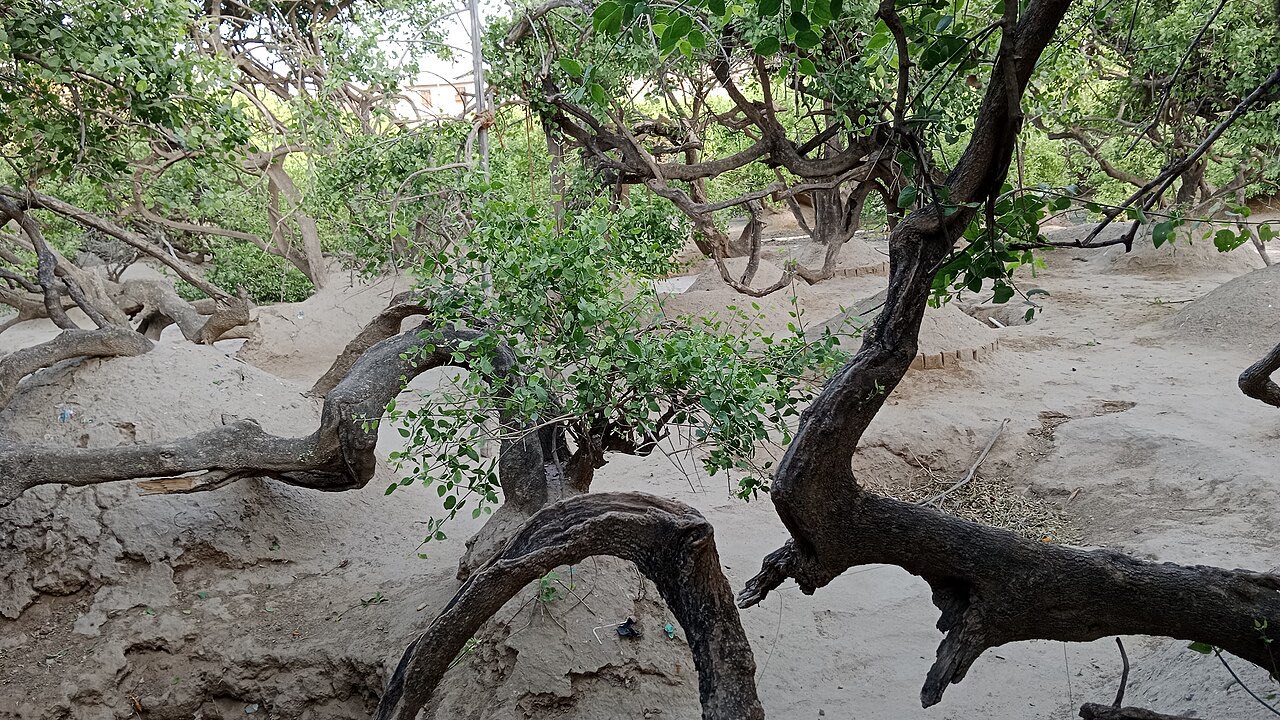
The locked garden — a grove of bowed tulsi trees that no one may enter after dark, and no one quite explains.
The bowed trees of the grove — photo by Kridha20, CC BY-SA 4.0, via Wikimedia Commons
- Town
- Vrindavan
- Deity
- Sacred grove of the rasa-lila; shrine of Rang Mahal
- Origins
- Sacred grove associated with Swami Haridas (16th century); site of Banke Bihari's manifestation
- Summer hours
- Roughly 5:00 am–8:00 pm; strictly closed and locked after evening
- Winter hours
- Roughly 6:00 am–7:00 pm; strictly closed and locked after evening
- Entry
- Free
- Dress code
- Modest, as everywhere in the old town. Move quietly; it is a shrine, not a park.
- Photography
- Tolerated in the grove's walkways, prohibited at the Rang Mahal shrine. Read the signs and follow the caretakers' word.
About the hours: Everyone — priests included — leaves before nightfall. That is the point. Confirm day hours locally.
Overview
Nidhivan is a walled grove in the middle of old Vrindavan where the trees grow wrong — bent double, braided into each other, canopies pressed toward the earth — and where every evening, without exception, the gates are locked and every human being leaves. The tradition is stated plainly by everyone from caretakers to neighbors: the rasa-lila happens here at night, Krishna and Radha dance in the grove, and it is not for mortal eyes. You may take the tradition literally, poetically, or anthropologically. Vrindavan takes it seriously, and that seriousness is the experience.
History
The grove is inseparable from Swami Haridas, the 16th-century saint and musician who performed his devotions here — and in whose worship, tradition records, the image of Banke Bihari manifested in this grove before being moved to its own temple in the 19th century. The small Rang Mahal shrine inside is prepared each evening as a bedchamber — bed made, water set out, sweets left — and shows signs of use each morning, say the caretakers, in the tradition’s most repeated detail.
Spiritual significance
Nidhivan (with its sister grove Seva Kunj nearby) preserves something older and stranger than temple worship: the sense of Braj itself as the theater of Krishna’s ongoing lila, not its memorial. The bowed tulsi trees are honored as gopis in waiting — participants, not scenery. This is the belief that underlies all of Vrindavan; Nidhivan is where it stands undiluted.
Visiting well
- Go in the late afternoon and watch the closing rituals begin — the grove’s daily emptying is the tradition in action.
- Keep voices low and phones mostly away; the caretakers’ instructions are the law here.
- The resident monkeys are numerous and confident — carry nothing loose (see safety).
- Combine with Banke Bihari for the full arc of the story: the grove where the deity appeared, then the temple where he reigns.
Festivals here
During Holi, the grove hosts flower celebrations tied to Swami Haridas’s tradition; Jhulan Yatra and Kartik bring decorated evenings — always concluded, as ever, before dark.
While you're here
Around Nidhivan
Nearby attractions
- Banke Bihari Mandir
- Ten minutes through the lanes — the deity worshipped there manifested in this grove.
- Seva Kunj
- Nidhivan's sister grove nearby, with the same nightly-lila tradition and the same locked evenings.
Eating & staying nearby
- Lane stalls toward Banke Bihari
- The walk between the two sites passes the old bazaar's full range of sweets and snacks.
- Where to stay
- Old-town guesthouses surround the area; the same trade-off as everywhere in the lanes — atmosphere over quiet. See the accommodation guide.
Festivals celebrated here:
Questions
Asked often.
- What happens in Nidhivan at night?
- Tradition holds that Krishna and Radha dance the rasa-lila in the grove every night — and that no living being may witness it. The compound is emptied and locked before nightfall, and local houses facing the grove famously keep no windows toward it.
- Why do the trees in Nidhivan look so strange?
- The grove's tulsi trees grow bent, paired, and intertwined toward the ground rather than upward — devotees hold that the trees themselves are gopis who join the nightly dance. Botanists offer drier theories. The trees decline to comment.
- Is Nidhivan worth visiting for a skeptic?
- Yes — as one of the most atmospheric places in Braj. Whatever one believes about the nights, the grove's hush, its bowed trees, and the seriousness with which Vrindavan treats the tradition tell you more about this town than any monument.
Visiting?
Planning a trip around Vrindavan?
Hourly, independent trip-planning help from a local — itineraries, bookings in your name, no commissions. The introduction is free.
amit@brajbhoomi.com