Temple · Vrindavan
Shri Madan Mohan Mandir
The oldest temple in Vrindavan — Sanatana Goswami's hilltop tower above the old bend of the Yamuna.
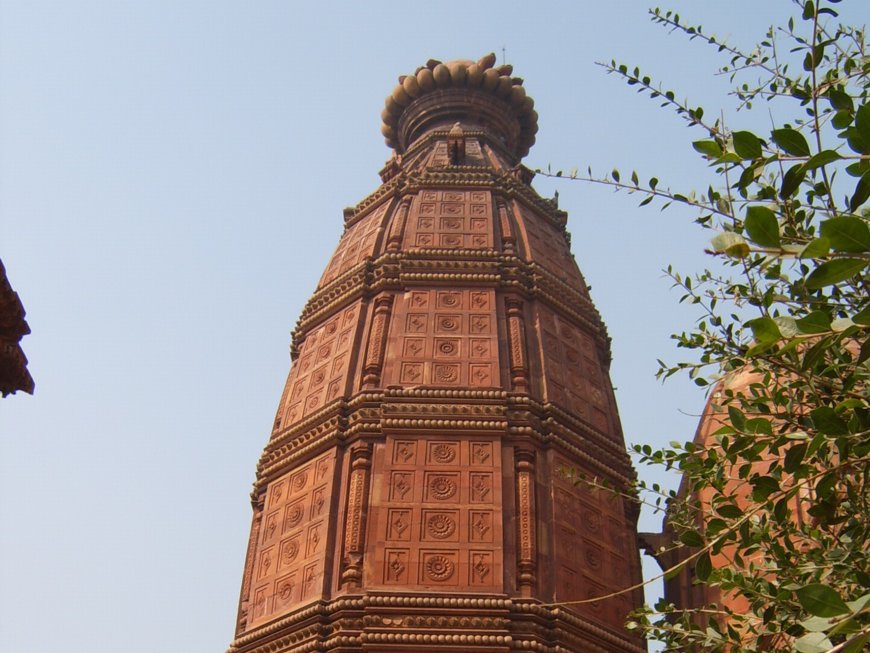
The sixteenth-century shikhara on Dvadashaditya hill — photo by GourangaUK, public domain, via Wikimedia Commons
- Town
- Vrindavan
- Deity
- Madan Mohan (Krishna, the enchanter of Cupid himself)
- Origins
- Deity served by Sanatana Goswami from the 1530s; sandstone temple raised c. 1580
- Summer hours
- Roughly 6:00 am–12:00 pm and 5:00–8:30 pm
- Winter hours
- Roughly 6:30 am–12:00 pm and 4:30–8:00 pm
- Entry
- Free
- Dress code
- Modest — shoulders and knees covered. The climb is short but the stone underfoot gets hot by late morning in summer.
- Photography
- The tower and river views are freely photographed; avoid the deity in the working shrine.
About the hours: The old tower is a protected monument open through the day; the working shrine below keeps regular service hours — confirm locally.
Overview
Before Vrindavan had temples, it had this hill. The sandstone tower of Madan Mohan on Dvadashaditya Tila, above the Yamuna’s old bend, is the town’s oldest surviving temple — raised around 1580 over the deity that Sanatana Goswami, the most senior of the six Goswamis, served in a thatched hut a half-century earlier. It is quieter than every famous shrine in town, and it is where the whole story starts.
History
Sanatana Goswami reached Vrindavan in the 1530s, the first of Chaitanya Mahaprabhu’s great scholars to settle here, and worshipped Madan Mohan — “the one who enchants even Cupid” — on this mound above the river. The temple came through commerce touched by grace: a Multani salt merchant, Ram Das Kapur, whose grounded boat floated free below the hill after he prayed to the deity, financed the sixty-foot sandstone tower in gratitude around 1580.
In the 1670s, ahead of Aurangzeb’s campaign against Vrindavan’s temples, the image was carried west and eventually settled in Karauli, where Rajasthan’s royal house still serves him. The old tower was damaged but stands; a newer shrine at the base of the hill continues the daily worship with a substitute image, as it has for three centuries.
Spiritual significance
Madan Mohan is one of Vrindavan’s three founding deities — with Govind Dev and Gopinath — installed by Chaitanya’s own circle, and in the tradition’s geography each governs one need of the soul: Madan Mohan severs attachment to the world, the first step of the path. That is why pilgrims are told to come here first, before Govind Dev and Gopinath, though few today know the order. The hill itself, sacred to the twelve Adityas, was old holy ground before the Goswamis ever arrived.
Visiting well
- Climb in the early morning, when the tower catches first light and the parikrama path below is a river of walkers.
- Look at the shikhara’s octagonal form — an unusual silhouette that makes the temple instantly recognizable from across town.
- Pay respects at the working shrine at the hill’s base; the monument above draws the eye, but the worship lives below.
- This is the contemplative end of Vrindavan — give it silence, and pair it with the parikrama rather than the bazaar.
Festivals here
Janmashtami and Jhulan Yatra are kept at the working shrine with old-quarter intimacy rather than spectacle, and through Kartik the hill and the parikrama path below fill with lamps and pre-dawn walkers — the temple’s best month by far.
While you're here
Around the temple
Nearby attractions
- Kali Ghat and the parikrama road
- The temple stands where the old town meets the Yamuna's former course — the parikrama path runs right below.
- The old-quarter temples
- Radha Raman, Radha Vallabh, and the groves are a fifteen-minute walk east through the lanes.
Eating & staying nearby
- Parikrama-road stalls
- Simple tea, snack, and prasad stalls serve the circumambulation route; fuller meals are back toward the bazaar.
- Where to stay
- This western edge of the old town is quiet — a handful of ashrams and guesthouses; most hotels lie toward the town center and beyond. See the accommodation guide.
Festivals celebrated here:
Questions
Asked often.
- Is this really Vrindavan's oldest temple?
- The oldest still standing — the sandstone tower dates to about 1580, a decade before Govind Dev, and the deity's worship on this hill goes back to Sanatana Goswami in the 1530s. Everything else you will visit in Vrindavan is younger.
- What is the story of the salt merchant?
- Tradition tells of Ram Das Kapur, a Multani salt trader whose loaded boat ran aground in the Yamuna below the hill. Sanatana Goswami told him to pray to Madan Mohan; the boat floated free, and the grateful merchant's fortune built the temple. Commerce and grace, in one founding story.
- Where is the original Madan Mohan deity?
- In Karauli, Rajasthan. Like Vrindavan's other great images, Madan Mohan was carried to safety ahead of Aurangzeb's demolitions in the 1670s and never returned; Karauli's royal temple still serves him. A substitute image continues the worship in the shrine at the foot of the hill here.
Visiting?
Planning a trip around Vrindavan?
Hourly, independent trip-planning help from a local — itineraries, bookings in your name, no commissions. The introduction is free.
amit@brajbhoomi.com