Temple · Mathura
Shri Krishna Janmabhoomi
The birthplace — a prison cell turned sanctum, and the reason Mathura exists on every pilgrim map.
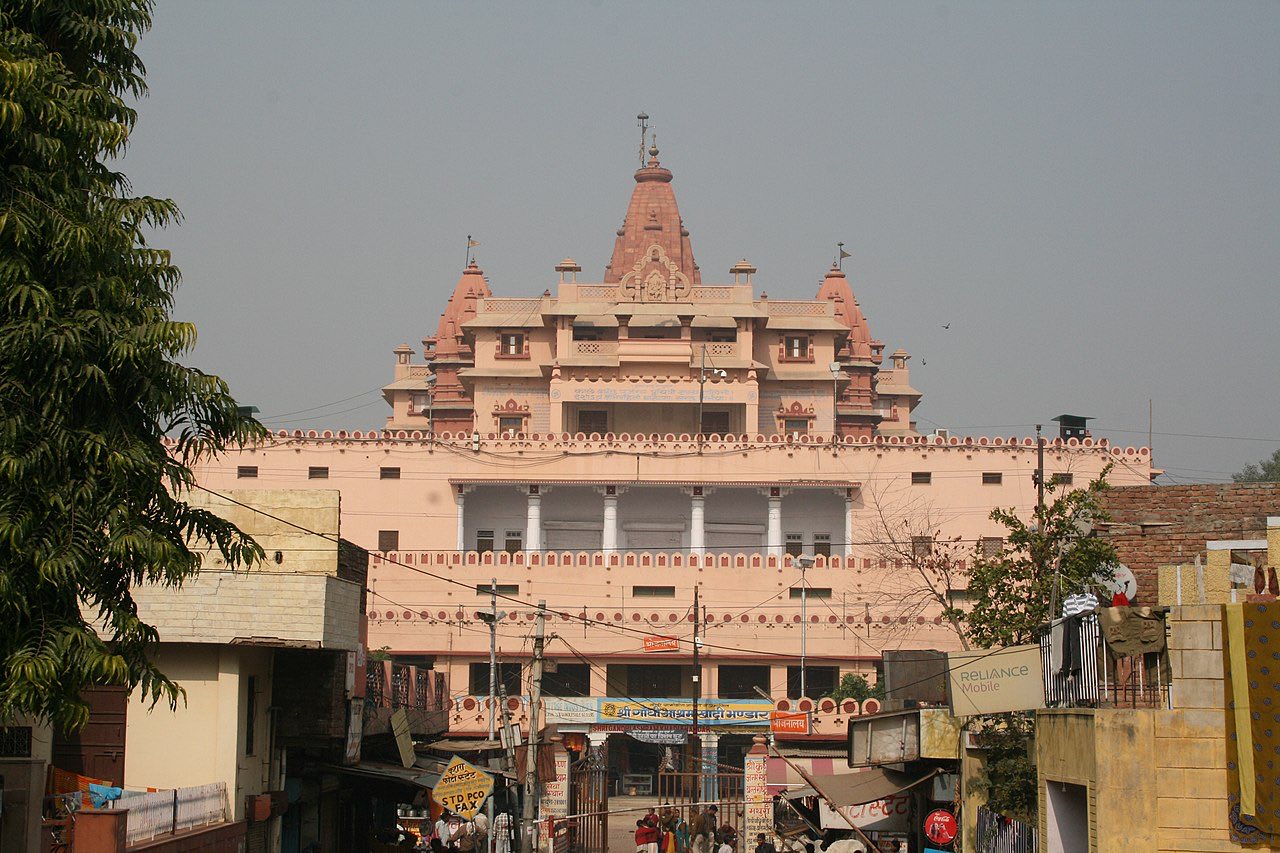
The Janmabhoomi complex above old Mathura — photo by Diego Delso, CC BY-SA 4.0, via Wikimedia Commons
- Town
- Mathura
- Deity
- Krishna (birthplace shrine); Keshavdev
- Origins
- Ancient site; current Keshavdev temple complex rebuilt mid-20th century
- Summer hours
- Roughly 5:00 am–12:00 pm and 4:00–9:30 pm
- Winter hours
- Roughly 5:30 am–12:00 pm and 3:00–8:30 pm
- Entry
- Free
- Dress code
- Modest — shoulders and knees covered.
- Photography
- Strictly prohibited. Phones, cameras, and bags must be deposited at the lockers outside — plan to enter carrying nothing.
About the hours: Security screening at entry adds time — arrive with patience and without prohibited items.
Overview
Everything in Braj radiates from this spot. The Janmabhoomi — “birth-ground” — marks the prison cell where Krishna is held to have been born at midnight, 5,000 years ago, while his uncle the tyrant Kansa slept. The complex today is part temple, part fortress, part archaeology of India’s layered history: a sanctum built as a dungeon, a great mid-century temple hall beside it, high walls, and the most serious security screening in the region.
History
The site’s history is long and scarred: ancient shrines rose here and were razed repeatedly — most consequentially the great Keshavdev temple, demolished in 1670 under Aurangzeb, with the Shahi Idgah mosque raised against its plinth. The modern complex was rebuilt through the mid-20th century by industrialist and devotional patronage, with the Garbha Griha (the prison-cell shrine) as its emotional center and the Keshavdev temple as its ceremonial one. The adjacency of mosque and temple keeps the site politically sensitive and the security permanent.
Spiritual significance
This is one of Hinduism’s principal birth-tirthas. The sanctum’s prison-cell form is the theology in miniature: divinity arriving in the darkest, most locked-down room in the kingdom, to parents in chains. At midnight on Janmashtami, when conches sound across the complex and the deity is bathed and revealed, the story completes itself annually before an enormous crowd.
Visiting well
- Travel light. Phones, cameras, and bags are barred — deposit them in the lockers outside or leave them at your hotel. Budget time for the queue and screening.
- Combine the visit with Vishram Ghat and the Dwarkadhish temple for the full old-Mathura circuit, and the Government Museum if sculpture moves you.
- Buy peda from one of the famous houses on the way out — Mathura’s signature sweet, and the correct souvenir.
- On Janmashtami, decide deliberately: the midnight crush here is vast. Families with small children celebrate more comfortably in Vrindavan.
Festivals here
Janmashtami is the event itself — the midnight of the year, with celebrations flowing through the whole city. Holi in Mathura peaks with the great processions and the color-drenched old bazaar between the temple and Holi Gate.
While you're here
Around Shri Krishna Janmabhoomi
Nearby attractions
- Vishram Ghat
- Mathura's principal Yamuna ghat, fifteen minutes away — evening aarti here completes the Mathura visit.
- Dwarkadhish Temple
- The old city's great 19th-century temple, on the way to the ghat through the bazaar.
- Government Museum, Mathura
- One of India's finest sculpture collections — the Mathura school of Buddhist and early Hindu art, criminally under-visited.
Eating & staying nearby
- Brijwasi and the Mathura peda shops
- Mathura's peda is the region's signature sweet; the famous houses cluster near the temple and Holi Gate.
- Holi Gate street food
- Kachori-jalebi breakfasts and chaat in the old bazaar — go where the crowd is thickest.
- Where to stay
- Mathura's hotels suit a night around a train connection or Janmashtami; for atmosphere over several days, most visitors still base in Vrindavan and visit from there. See the accommodation guide.
Festivals celebrated here:
Questions
Asked often.
- Why is there a prison cell inside the temple?
- Krishna, the tradition holds, was born in the prison of King Kansa, where his parents Devaki and Vasudeva were held. The Garbha Griha shrine marks that cell — the sanctum of the complex is deliberately a dungeon, not a palace.
- Why is security so strict at Krishna Janmabhoomi?
- The site adjoins a mosque built in 1670 after Aurangzeb's demolition of the previous temple, and the complex has been a sensitive site for decades. Screening is airport-style; phones and bags go into lockers outside. It is routine — allow the time and carry nothing.
- Is Janmashtami at the birthplace worth the crowds?
- It is the definitive place to be at midnight on Krishna's birthday — and among the largest religious gatherings in north India that night. Go if crowds energize you; watch from Vrindavan if they don't.
Visiting?
Planning a trip around Mathura?
Hourly, independent trip-planning help from a local — itineraries, bookings in your name, no commissions. The introduction is free.
amit@brajbhoomi.com