Temple · Barsana
Kirti Mandir (Rangeeli Mahal)
A temple for the mother — white marble at the foot of Radha's hill, holding the divine child in her mother's lap.
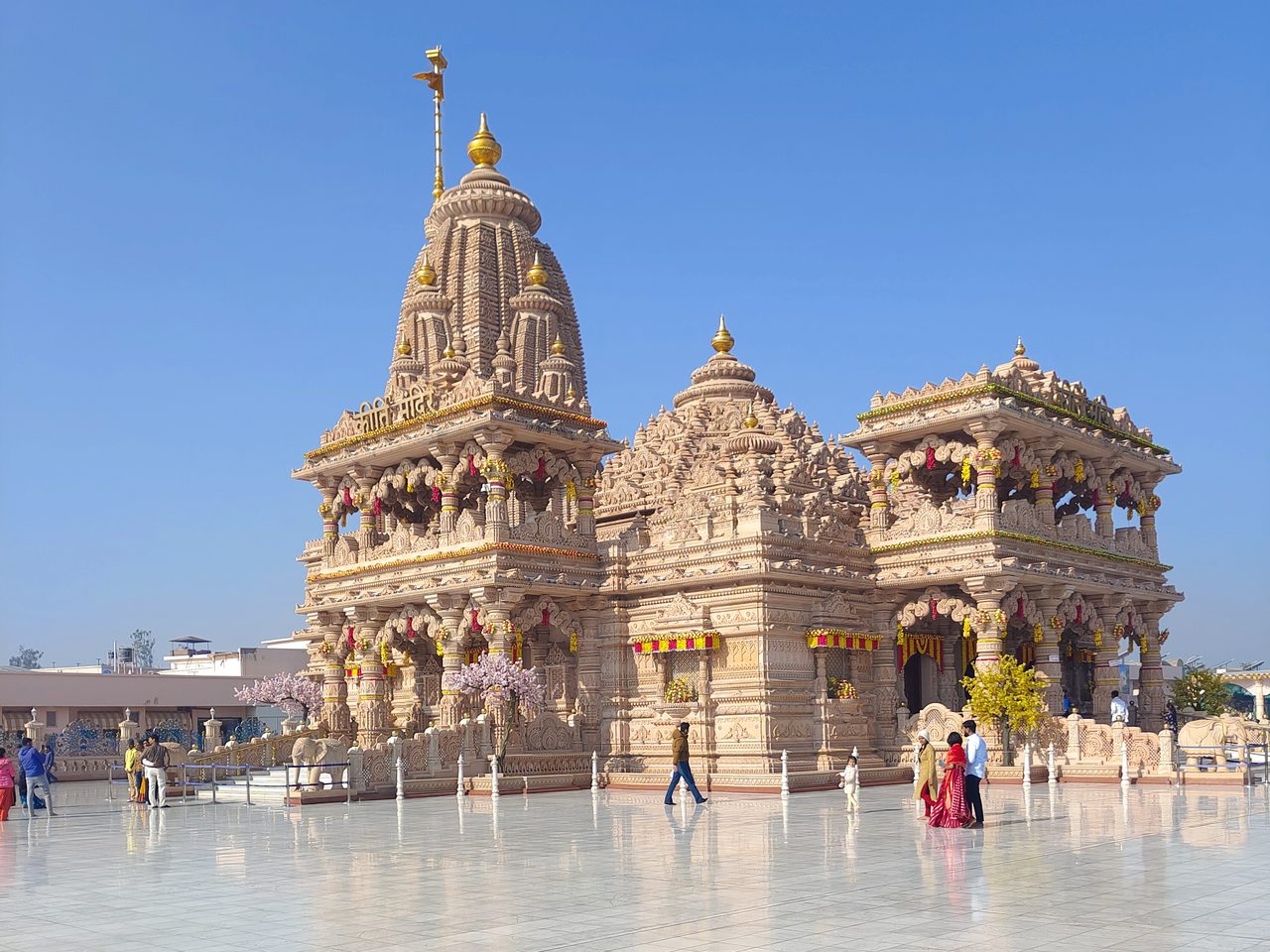
The temple across its marble plaza — photo by Avinashjha1806, CC BY-SA 4.0, via Wikimedia Commons (cropped)
- Town
- Barsana
- Deity
- Kirti Maiya with the child Radha — the only great temple of Radha's mother
- Origins
- Built by the Jagadguru Kripalu Parishat; inaugurated 2019
- Summer hours
- Roughly 5:30 am–12:00 pm and 4:30–9:00 pm
- Winter hours
- Roughly 6:00 am–12:00 pm and 4:30–8:30 pm
- Entry
- Free
- Dress code
- Modest — shoulders and knees covered; the marble plaza is shoe-free and scorching by midday in summer.
- Photography
- Freely permitted across the plaza and halls; restrictions apply near the deities — follow signage.
About the hours: A large modern institution with posted darshan and aarti times — the most predictable schedule in Barsana.
Overview
Barsana’s hilltop belongs to the daughter; since 2019, the base of the hill has belonged to the mother. Kirti Mandir — the Rangeeli Mahal complex — is a vast white marble temple raised to Kirti Maiya, Radha’s mother, with the divine child seated in her lap: an inversion of every altar in Braj, and one of the very few great temples anywhere dedicated to the mother of the divine. Ancient above, brand-new below, Barsana now holds both ends of the story.
History
The temple was built by the Jagadguru Kripalu Parishat, the institution of Jagadguru Kripalu Maharaj, whose devotional theology gave Radha absolute primacy — and who conceived a temple honoring the woman who raised her. Completed and inaugurated in 2019, after its founder’s passing, it joined his trio of major Braj-region temples and instantly became Barsana’s largest building: carved shikharas over a marble plaza, darshan halls built for festival crowds, and an institutional calm the old hilltop shrine has never had room for.
Spiritual significance
Braj devotion runs on intimate relationships with God — friend, servant, beloved, parent. Kirti Mandir extends the chain one link further: honoring the one who mothered the beloved herself. In Barsana’s lived tradition Radha is Laadli, the darling daughter of Vrishabhanu and Kirti’s house, and the town’s identity is that household. The temple gives the tradition’s most overlooked figure her seat — and pilgrims who climb to Shriji afterward feel the two temples complete each other, lap to throne.
Visiting well
- Do the pairing properly: Kirti Mandir first, then the 200-step climb to Shriji — mother’s blessing before the daughter’s darshan, as Barsana etiquette has it.
- The marble plaza burns barefoot feet from late morning in summer — go early, or evening for the aarti when the lit shikharas are at their best.
- The complex is the practical base for Barsana: clean facilities, canteen, and the town’s most reliable information desk.
- At Lathmar Holi and Radhashtami the temple absorbs the overflow crowds — a saner darshan when the hilltop is impassable.
Festivals here
Radhashtami — Radha’s appearance day — is celebrated here as a birth in the family home, with the child-Radha image at the center of it. Holi week fills the plaza as Barsana’s festival machinery runs at full tilt, and the temple’s own calendar of Kripalu-tradition observances keeps the halls busy year-round.
While you're here
Around Kirti Mandir (Rangeeli Mahal)
Nearby attractions
- Shriji (Radha Rani) Mandir
- Radha's hilltop palace rises directly above — the mother at the base, the daughter on the crown of the hill.
- Prem Sarovar and Mor Kutir
- The quieter lila sites on Barsana's edges make an easy circuit by rickshaw.
Eating & staying nearby
- Barsana bazaar
- Lassi, pakora, and thali houses in the market below the hill; the temple complex also runs a clean canteen.
- Where to stay
- The temple's own guest facilities are the most comfortable rooms in Barsana; the town otherwise offers basic guesthouses that vanish entirely around Holi and Radhashtami. See the accommodation guide.
Festivals celebrated here:
Questions
Asked often.
- Who is Kirti Maiya?
- Radha's mother — wife of Vrishabhanu, the chief of Barsana. Temples to the divine couple are numberless; a great temple to the mother of the divine is nearly unique, and that reversal of attention is the whole point of Kirti Mandir.
- Why show Radha as a child?
- The central image sets the child Radha in Kirti's lap — vatsalya, parental love, offered toward Radha rather than Krishna for once. Braj tradition holds Barsana as the seat of her childhood, so here she is the daughter of the house.
- Is a modern temple worth visiting among Braj's ancient ones?
- This one, yes — as living proof that Braj is still building for its devotion, not curating a museum. The craftsmanship is serious, the plaza at aarti is stirring, and its pairing with the ancient hilltop Shriji above makes the old-and-new point better than any guidebook.
Visiting?
Planning a trip around Barsana?
Hourly, independent trip-planning help from a local — itineraries, bookings in your name, no commissions. The introduction is free.
amit@brajbhoomi.com