Temple · Vrindavan
Shri Govind Dev Mandir
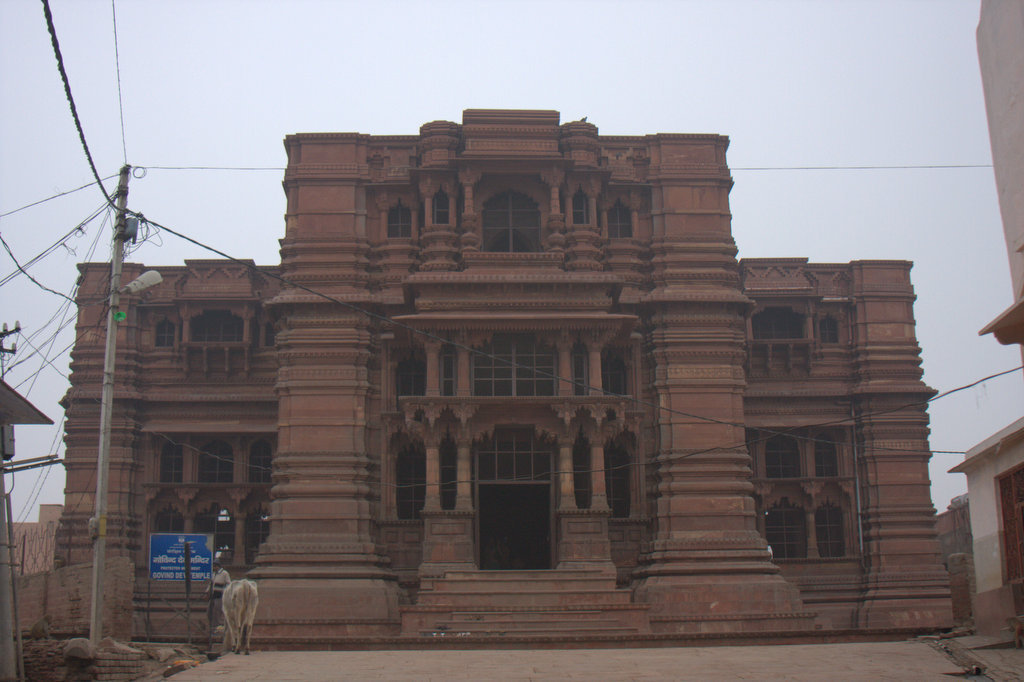
The red sandstone colossus of 1590 — the grandest temple ever raised in Braj, and still its most astonishing building.
The sandstone mass of Govind Dev — photo by Vishwanath Hawargi, CC BY-SA 3.0, via Wikimedia Commons
- Town
- Vrindavan
- Deity
- Govind Dev (Krishna as the cowherd lord)
- Origins
- Deity recovered by Rupa Goswami c. 1533; present temple completed 1590 by Raja Man Singh I of Amber
- Summer hours
- Roughly 7:00 am–12:00 pm and 4:00–8:30 pm
- Winter hours
- Roughly 7:30 am–12:00 pm and 4:00–8:00 pm
- Entry
- Free
- Dress code
- Modest — shoulders and knees covered. Comfortable shoes help; the compound is large and the stone floors run hot in summer.
- Photography
- The exterior and courtyard are freely photographed and worth the trip alone; avoid the deity and follow posted ASI signage.
About the hours: Part ASI-protected monument, part working shrine — the compound stays open through the day but aarti hours shift with season; confirm locally.
Overview
Every other temple in Vrindavan asks you to feel; Govind Dev also asks you to look. Completed in 1590 with imperial sanction and imperial money, it was the largest and most sophisticated Hindu temple of its era in the north — a cruciform hall of deep red sandstone whose vaulted nave reminded early European visitors of a cathedral. Even reduced to a fraction of its original height, it remains the most architecturally astonishing building in Braj.
History
The deity came first. Around 1533, Rupa Goswami — the senior of the six Goswamis sent to Vrindavan by Chaitanya Mahaprabhu — recovered the image of Govind Dev at Gomatila, and a modest shrine rose over it. Two generations later, Raja Man Singh I of Amber, the foremost Rajput general of Akbar’s court, financed a temple to match the deity’s standing. Finished in 1590, it rose seven storeys, and a lamp burned at its summit that — the story goes — could be seen from Agra.
That visibility became its undoing. Around 1670, Aurangzeb’s forces pulled down the upper storeys; the priests had already carried the deity west to safety, and after years of wandering he settled in Jaipur, where Govind Dev Ji now presides beside the City Palace. The truncated Vrindavan building passed into protection as a monument, but its sanctum was reconsecrated, and worship has continued in it ever since.
Spiritual significance
For Gaudiya Vaishnavas, Govind Dev is one of the three original deities of Vrindavan — with Madan Mohan and Gopinath — installed by the direct associates of Chaitanya himself. The three formed the devotional axis of the town before any of today’s famous temples existed. That the building now standing is a fragment matters less than whose deity it was built for: this is ground zero of Vrindavan’s sixteenth-century renaissance.
Visiting well
- Come in late-afternoon light, when the sandstone goes molten — the best hour for the exterior.
- Walk the outside before you enter: the carved plinth, the scale of the walls, and the abrupt flat top where four more storeys once stood tell the whole story silently.
- Inside, look up — the vaulted stone ceiling of the nave is unique in Braj and easy to miss in the dimness.
- Pair it with Rangji Mandir next door for Vrindavan’s two great architectural surprises in a single walk.
Festivals here
Janmashtami fills the old hall past midnight; Jhulan Yatra brings swing pavilions to the courtyard in the monsoon; and through Kartik, lamps along the sandstone recover — for a month — a little of what that summit flame must have looked like from the road to Agra.
While you're here
Around the temple
Nearby attractions
- Rangji Mandir
- The vast South Indian temple compound is a few minutes' walk east — the two most architecturally startling buildings in Vrindavan, back to back.
- Nidhivan
- The sacred grove lies a short walk into the old town's lanes.
Eating & staying nearby
- Main-road sweet houses
- The Mathura–Vrindavan road nearby holds reliable pede and khurchan shops, calmer than the Banke Bihari bazaar crush.
- Where to stay
- The temple sits at the edge of the old town, so everything from simple dharamshalas to Vrindavan's better hotels is within a short rickshaw hop. See the accommodation guide.
Festivals celebrated here:
Questions
Asked often.
- Why does Govind Dev temple look unfinished?
- It isn't unfinished — it was cut down. The temple originally rose seven storeys; tradition and the record agree that its upper levels were demolished on Aurangzeb's orders around 1670. What remains is only the base of the building, which tells you how staggering the whole must have been.
- Where is the original Govind Dev deity now?
- In Jaipur. The image was carried out of Vrindavan ahead of the demolitions and eventually installed beside the City Palace, where Govind Dev Ji remains Jaipur's most beloved deity. Worship in Vrindavan continues with substitute images consecrated in the old sanctum.
- Is Govind Dev worth visiting if I'm short on time?
- If you care at all about architecture, yes — it is among the most important sixteenth-century buildings in northern India, a red sandstone hall with a vaulted ceiling unlike anything else in Braj. Twenty minutes here recalibrates your sense of what Vrindavan was.
Visiting?
Planning a trip around Vrindavan?
Hourly, independent trip-planning help from a local — itineraries, bookings in your name, no commissions. The introduction is free.
amit@brajbhoomi.com