Temple · Mathura
Dwarkadhish Mandir
Mathura's merchant-built jewel — carved courtyards, Rajasthani color, and the old city's daily devotional pulse.
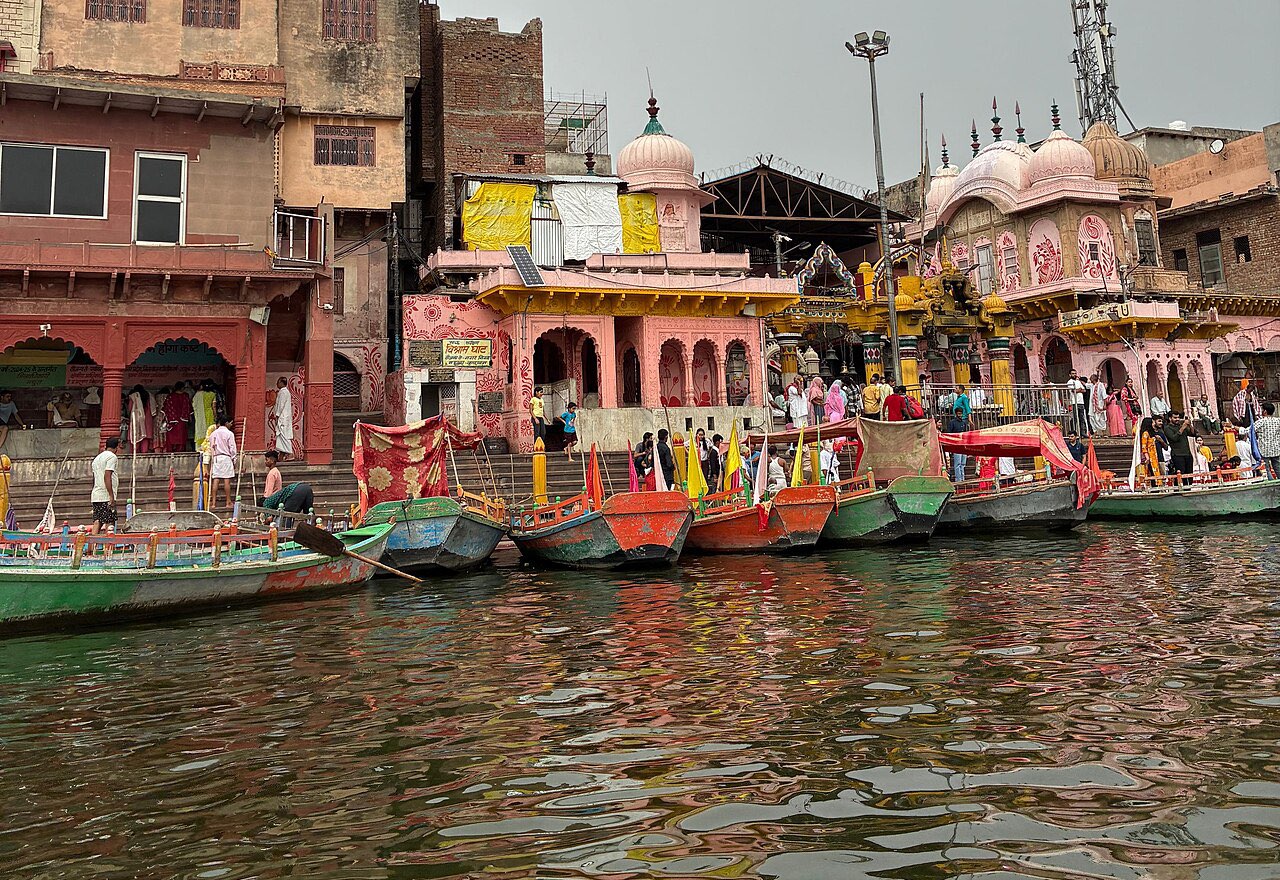
Vishram Ghat, a two-minute walk from the temple — photo by Bakeil, CC0, via Wikimedia Commons
- Town
- Mathura
- Deity
- Dwarkadhish (Krishna as the King of Dwarka)
- Origins
- Built 1814 by Seth Gokul Das Parikh, treasurer of Gwalior state
- Summer hours
- Roughly 6:30 am–12:30 pm and 4:00–7:00 pm
- Winter hours
- Roughly 6:30 am–12:30 pm and 3:30–6:30 pm
- Entry
- Free
- Dress code
- Modest — shoulders and knees covered.
- Photography
- Not permitted inside; the painted courtyard ceilings will tempt you anyway. Respect the rule.
About the hours: A working Pushtimarg temple — the day runs on darshan periods (jhanki) rather than continuous opening; confirm the day's schedule at the gate.
Overview
Dwarkadhish is the old city of Mathura’s principal temple and its most beautiful building — an 1814 merchant commission whose modest street entrance opens into a carved courtyard of painted ceilings, scalloped Rajasthani arches, and a black marble Krishna enthroned as the King of Dwarka. Where the Janmabhoomi is solemn and fortified, Dwarkadhish is urbane and alive: the temple of the bazaar that surrounds it, running on the rhythm of shopkeepers’ darshan since the East India Company era.
History
The temple was built by Seth Gokul Das Parikh, treasurer of Gwalior state, in 1814, and passed into the care of the Pushtimarg tradition of Vallabhacharya. It is, by Braj standards, young — but it inherited the role of old Mathura’s civic temple, and two centuries of continuous bazaar devotion have given it the patina older monuments envy.
Spiritual significance
In Pushtimarg practice the deity is served as a royal child: the day is structured as a sequence of jhankis — dressed viewings — with the deity woken, adorned, fed, and rested in courtly style. Krishna appears here not as Braj’s cowherd but as the sovereign he became — a reminder, in the middle of his childhood country, of where the story leads. The temple’s Holi and monsoon Hindola (swing) traditions are the old city’s proudest.
Visiting well
- Check the day’s jhanki schedule at the gate and time your visit to one — between viewings the sanctum is closed.
- Look up in the courtyard: the painted ceilings are the finest detail in Mathura’s old city.
- Walk on to Vishram Ghat afterward through the bazaar — temple, lanes, and evening Yamuna aarti make one seamless old-Mathura circuit.
- Weekday mornings are local and unhurried; festival days are gloriously otherwise.
Festivals here
Holi at Dwarkadhish is the old city’s signature celebration — days of color, music, and the courtyard packed to its painted rafters. Janmashtami and the monsoon swing festival (Hindola/Jhulan) are the other high points of its year.
While you're here
Around the temple
Nearby attractions
- Vishram Ghat
- Five minutes' walk — Krishna is said to have rested here after defeating Kansa; evening aarti on the Yamuna is the old city's daily finale.
- The old bazaar
- The lanes between temple and ghat are Mathura's living commercial history — brass, sweets, cloth, and noise.
Eating & staying nearby
- Peda houses of the bazaar
- Mathura's famous sweet at its source — the venerable shops cluster within a few hundred meters.
- Kachori breakfast stalls
- The old city's morning ritual — kachori-sabzi and jalebi, eaten standing, before darshan.
- Where to stay
- Old-city hotels put you inside the atmosphere and the noise alike; most international visitors day-trip here from Vrindavan. See the accommodation guide.
Festivals celebrated here:
Questions
Asked often.
- What tradition does Dwarkadhish Mathura belong to?
- The temple is run in the Pushtimarg (Vallabhacharya) tradition, in which the deity is served as a royal child through a daily sequence of jhankis — dressed viewings — rather than continuous darshan. The day's schedule is posted at the temple.
- Is this the same Dwarkadhish as the famous Dwarka temple in Gujarat?
- Same form of Krishna — Dwarkadhish, the King of Dwarka — different temple and tradition. Mathura's was built in 1814 by a wealthy Gwalior treasurer and is the principal Krishna temple of the old city.
- When is Dwarkadhish Mathura at its best?
- Holi, without question — its courtyard celebrations and the huladang festivities are the old city's most famous — and during Janmashtami week, when all of Mathura runs at festival pitch.
Visiting?
Planning a trip around Mathura?
Hourly, independent trip-planning help from a local — itineraries, bookings in your name, no commissions. The introduction is free.
amit@brajbhoomi.com