Temple · Baldeo
Dauji Mandir (Baldeo)
The elder brother's seat — Braj's great Balarama temple, and home of the wildest Holi afterparty in India.
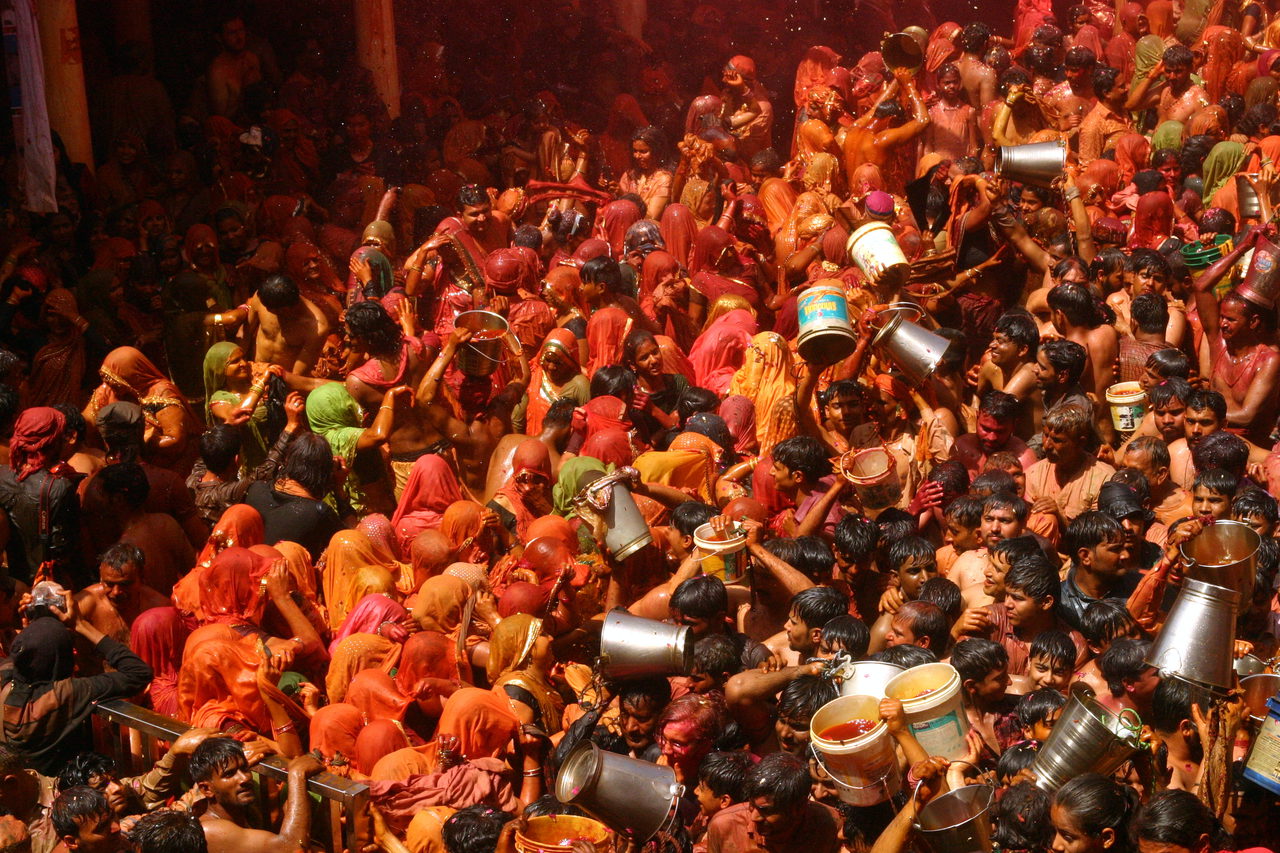
Huranga in the temple courtyard, the day after Holi — photo by Retlaw Snellac Photography, CC0, via Wikimedia Commons
- Town
- Baldeo
- Deity
- Dauji (Balarama, Krishna's elder brother) with Revati
- Origins
- Deity held to be from Vajranabha's original consecrations, recovered from the adjacent kund and enthroned in the 16th century
- Summer hours
- Roughly 5:30 am–12:00 pm and 4:00–9:00 pm
- Winter hours
- Roughly 6:00 am–12:00 pm and 4:00–8:30 pm
- Entry
- Free
- Dress code
- Modest — shoulders and knees covered. On Huranga day, wear clothes you are prepared to lose.
- Photography
- Tolerated in the courtyard on ordinary days; during Huranga the temple manages photographers from the galleries — arrange early, the vantage points fill fast.
About the hours: Village-temple rhythm, and on Huranga day the ordinary schedule dissolves entirely.
Overview
Braj is Krishna’s country, but one town belongs to the elder brother. In Baldeo, an hour southeast of Mathura, Dauji — Balarama — presides over his principal temple anywhere in India: a heavy, dark, garlanded image served by the same families for centuries, with his wife Revati enshrined facing him and a sacred kund at his side. Fifty-one weeks a year it is a deep, quiet village shrine. In the fifty-second, its courtyard hosts the Huranga — Holi’s day-after battle of color, water, and torn shirts that may be the most cheerfully violent act of devotion on earth.
History
The image is counted among Vajranabha’s original consecrations of Braj — lost in the long centuries and recovered, tradition says, from the tank beside the temple now called Balbhadra Kund or Kshir Sagar. Enthroned in the sixteenth century as Braj’s devotional revival gathered pace, Dauji has been served ever since by the town’s hereditary priestly families, whose Huranga — the festival they stage and star in — has run unbroken for generations. The village took its lord’s name: Baldeo.
Spiritual significance
Balarama is Braj’s understated pillar: elder brother, plough-bearer, the strength that walks beside the flute. The tradition honors him as Krishna’s first companion in every lila — and in Baldeo the hierarchy gently inverts, with Dauji as the seat’s master and his brother the beloved guest. Pilgrims doing the full Braj circuit come here to complete the family: Krishna’s towns, Radha’s town, the parents’ towns — and the brother’s.
Visiting well
- Pair Baldeo with Gokul and Mahavan — one road trip covers Krishna’s infancy and his brother’s seat.
- Buy the town’s pede — Baldeo’s milk sweets are the offering of record and among the best in the region.
- Visit the kund beside the temple; the deity’s recovery from its water is the town’s founding memory.
- For Huranga: arrive very early, expect to be drenched and dyed head to foot, carry nothing you can’t waterproof, and know that the courtyard is dense, loud, and physical — watch from the galleries if that’s not your festival.
Festivals here
The Huranga, the day after Holi, is the temple’s world-famous hour — vats of saffron water, flying color, and the women’s ritual whip-hand over the men. Balarama Jayanti (Shravan Purnima), the deity’s appearance day, is the quieter, deeper feast, and Janmashtami here celebrates the younger brother with an elder brother’s indulgence.
While you're here
Around Dauji Mandir (Baldeo)
Nearby attractions
- Balbhadra Kund (Kshir Sagar)
- The tank beside the temple from which the deity was recovered — the town's second sacred center.
- Gokul and Mahavan
- Krishna's infancy sites lie on the road back toward Mathura — Baldeo pairs naturally with a Gokul half-day.
Eating & staying nearby
- Baldeo's pede shops
- The town is known for its milk sweets — Dauji's offerings run on them, and so should you.
- Where to stay
- Effectively none — Baldeo is a village visit from Mathura or Vrindavan, an hour's drive out and back. See the accommodation guide.
Festivals celebrated here:
Questions
Asked often.
- Who is Dauji?
- Balarama — Krishna's elder brother, the plough-bearer, worshipped across Braj as Dauji, "the elder." This is his principal temple anywhere, and in Baldeo he is the presiding lord outright, with Krishna the visiting relative for once. His consort Revati is enshrined facing him.
- What is the Huranga?
- The day after Holi, Dauji's courtyard hosts a ritual battle beyond even Barsana's — men drench the courtyard in colored water from great vats, and the women, given ritual license, tear the men's shirts to ribbons and thrash them with the soaked cloth. It is deafening, drenching, and one of the great spectacles of India. The temple's serving families have run it for generations.
- How did the deity get here?
- Tradition counts the massive image among Vajranabha's original installations, lost to time and recovered from the kund beside the temple — pulled from the water and enthroned in the sixteenth century, since when the same community of serving families has kept the worship.
- Is Baldeo worth the trip on a non-festival day?
- For the unhurried version of Braj, yes — a working village temple with real weight, no tourist apparatus, excellent pede, and the kund alongside. For the Huranga version, plan a year ahead and hold onto your shirt.
Visiting?
Planning a trip around Baldeo?
Hourly, independent trip-planning help from a local — itineraries, bookings in your name, no commissions. The introduction is free.
amit@brajbhoomi.com