Temple · Vrindavan
Shri Banke Bihari Mandir
The beating heart of Vrindavan — mischievous, crowded, and unlike any other darshan in India.
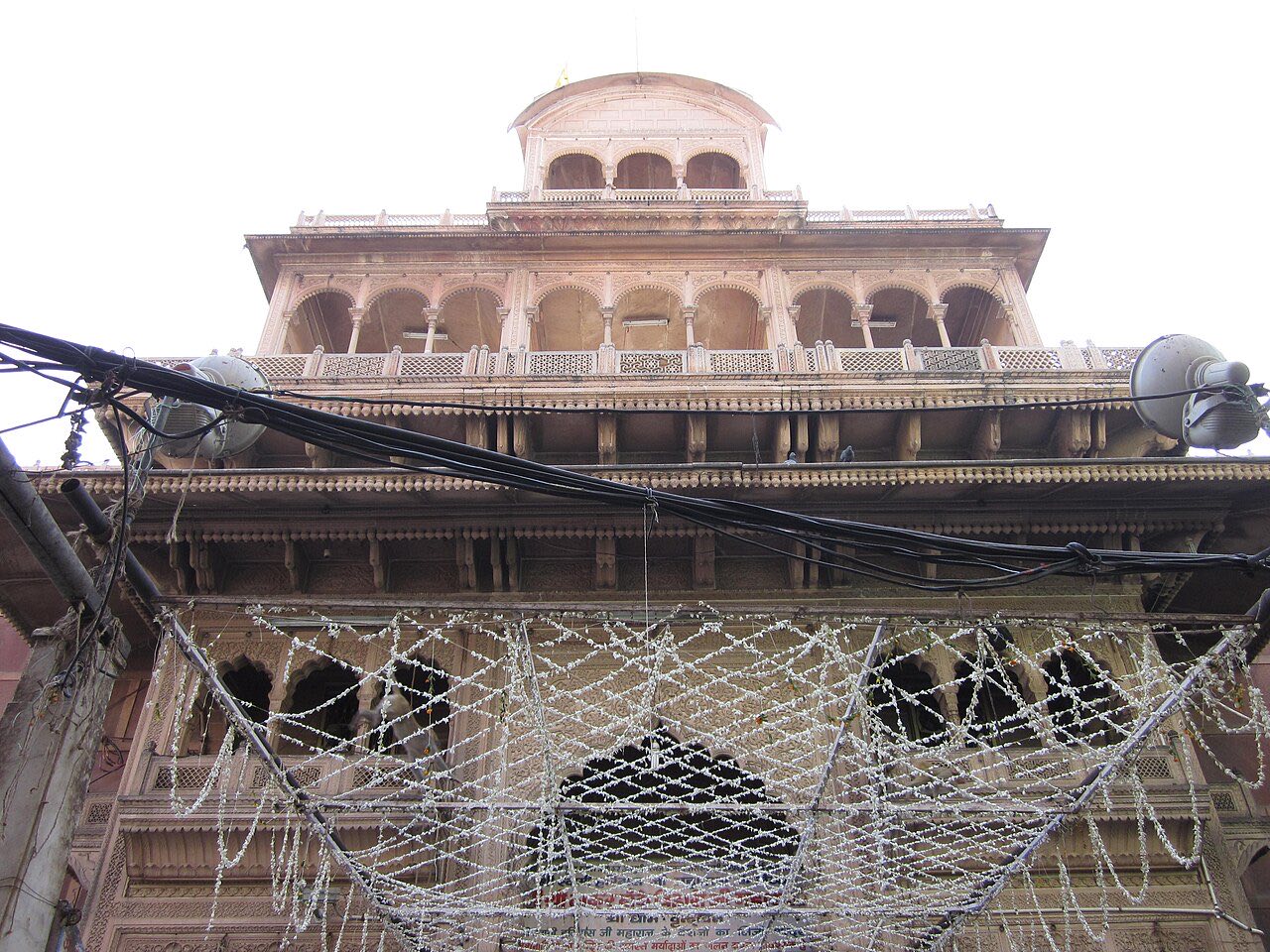
The facade from the lane below — photo by Guptaele, CC BY-SA 4.0, via Wikimedia Commons
- Town
- Vrindavan
- Deity
- Banke Bihari (Krishna, "the one bent in three places")
- Origins
- Current temple built 1864; the deity's worship traces to Swami Haridas in the 16th century
- Summer hours
- Roughly 7:45 am–12:00 pm and 5:30–9:30 pm
- Winter hours
- Roughly 8:45 am–1:00 pm and 4:30–8:30 pm
- Entry
- Free
- Dress code
- Modest — shoulders and knees covered. Cloth bags preferred over leather.
- Photography
- Not permitted inside. Keep phones pocketed; monkeys outside actively steal them anyway.
About the hours: Hours shift with season and festivals — confirm locally on the day. Mangala aarti happens only once a year, on Janmashtami.
Overview
If Vrindavan has a heartbeat, it is here. Banke Bihari is not the town’s oldest temple, nor its grandest building, but it is where Vrindavan’s devotion runs at its highest voltage — a Rajasthani-style haveli in the middle of the old bazaar lanes where darshan is less a viewing than an event, complete with surging crowds, ecstatic cries of “Banke Bihari Lal ki jai!”, and a curtain that opens and closes over the deity like a slow, teasing heartbeat.
History
The image of Banke Bihari is credited to Swami Haridas — the 16th-century saint-musician of the Nimbarka/sakhi tradition and, famously, the guru of Tansen — to whom the deity is said to have appeared in the grove of Nidhivan. The current temple was completed in 1864, funded by devotees, and the deity was moved from Nidhivan into the new sanctum. The style is that of a grand haveli rather than a spired mandir: courtyards, arches, and a sanctum that opens directly onto the pressing crowd.
Spiritual significance
Banke means “bent in three places” — the classic tribhanga pose of Krishna with flute. Uniquely, the deity here is treated less as a king to be petitioned than as a child and beloved to be adored: no bells are rung inside (they might startle him), mangala aarti is held only once a year, and the curtain ritual exists — so the tradition says — because his gaze is too potent to be met for long. Devotees don’t come here to ask. They come to see and be seen.
Visiting well
- Come on a weekday, right at opening — the closest the temple gets to calm.
- Go with the flow of the crowd; there is no standing still at the front, and the movement is managed.
- Keep phones, glasses, and prasad boxes zipped away — the monkeys of these lanes are the boldest in Vrindavan; see the safety guide.
- Small children and unsteady elders should visit at off-peak hours; festival crowds are genuinely intense.
- The lanes themselves are half the experience — arrive on foot from the old town rather than driving to the gate.
Festivals here
Holi week at Banke Bihari includes the famous Phoolwali Holi (Holi of flowers) and some of the densest, most joyous crowds in Braj. Janmashtami brings the year’s only mangala aarti at 2 am — an event people plan whole trips around. Jhulan Yatra in the monsoon sees the deity on golden swings, and in Kartik, the whole quarter glows with lamps.
While you're here
Around the temple
Nearby attractions
- Radha Vallabh Temple
- A few lanes away — one of Vrindavan's oldest living traditions, quieter and profoundly atmospheric.
- Nidhivan
- The walled sacred grove tied to the temple's own origin story, ten minutes' walk.
- Vishram Ghat corridor lanes
- The bazaar lanes between the temple and the Yamuna are old Vrindavan at full volume.
Eating & staying nearby
- The lane sweet shops
- The temple lanes are lined with generations-old halwais — try khurchan, peda, and hot jalebi at whichever counter is busiest.
- Old-town thali houses
- Simple pure-veg thalis within five minutes' walk; busy at 1 pm is the quality signal.
- Where to stay
- The lanes around the temple hold the most atmospheric guesthouses in Vrindavan — and the least sleep. Bells begin before 5 am. Staying a short e-rickshaw ride away trades atmosphere for rest; see the accommodation guide. See the accommodation guide.
Festivals celebrated here:
Questions
Asked often.
- Why does the curtain keep closing in front of the deity?
- It is the temple's signature ritual — the curtain (parda) is drawn every few minutes because, tradition holds, no one should gaze too long into Banke Bihari's eyes lest the beholder be swept away entirely. The rhythm of reveal and concealment is the darshan.
- When is Banke Bihari least crowded?
- Weekday mornings right at opening, outside festival seasons. Weekends, Holi week, Janmashtami, and Jhulan Yatra bring extraordinary crowds — beautiful, but not gentle.
- Is there a special queue or paid darshan?
- No VIP tickets exist — Banke Bihari is famously egalitarian. Anyone promising paid fast-track darshan outside is selling something that isn't theirs to sell.
Visiting?
Planning a trip around Vrindavan?
Hourly, independent trip-planning help from a local — itineraries, bookings in your name, no commissions. The introduction is free.
amit@brajbhoomi.com